

How to Budget Money for Beginners: A Simple Step-by-Step Guide
Budgeting for beginners made simple: how to budget money in five steps, a first-month example, and budgeting tips that survive past month two.
Here is the thing nobody tells you about budgeting: it is not the setup that defeats people. It is the second month.
Almost anyone can build a budget on a motivated Sunday. The categories look tidy, the math adds up, and then real life arrives, a surprise bill, a hard week, a dinner out you did not plan, and by the second month the whole thing quietly collapses. You did not fail at budgeting. You built a system that was never designed to survive a normal life.
So let us build one that is. This guide sets up a budget you will actually keep, not a perfect one you will abandon, and it starts simpler than most guides dare to, on purpose.
The short answer
Budgeting for beginners starts with last month, not a perfect template: list what actually came in, list what actually went out, give the next month five simple categories, and check in weekly. If you can do that for two months, you have a budget that works — even if the numbers are messy at first.
Budgeting tips for beginners that actually survive month two
Most budgeting tips for beginners fail because they ask for too much precision too early. These survive because they are forgiving:
- Budget what you earned last month, not what you hope to earn. This one change removes most of the guilt from a variable or tight income.
- Use five categories, not twenty. Needs, wants, debt, savings, and one buffer category for the surprise that always arrives.
- Pick one method and stay a season. 50/30/20, zero-based, and pay-yourself-first can all work. Compare them in best budgeting methods for beginners instead of switching every fortnight.
- Plan the overspend. A small “life happens” line is not cheating. It is what keeps one dinner out from becoming “the budget is ruined”.
What a budget is actually for
Forget the word budget for a second, because it carries baggage. It sounds like restriction. It sounds like a spreadsheet judging you.
A budget is really just a noticing habit. It is the difference between money happening to you and money happening because of you. That is the entire benefit, not deprivation, just awareness. And awareness alone fixes more than you would expect, because most overspending is not a choice. It is autopilot you never looked at.
So the goal of your first budget is not precision. It is a level of attention you can sustain.
The five steps to your first budget
You can do this in under an hour.
1. Find your real take-home pay. Not your salary, the number that actually lands in your account after tax. If your pay varies, note your lowest recent month and start there. More on that in how to budget on an irregular income.
2. List the bills you cannot skip. Rent, utilities, transport, insurance, phone, minimum debt payments, groceries. Whatever is left after these is the money your choices live in.
3. Track for two to four weeks, do not budget yet. This is the step everyone skips, and it is the one that makes the whole thing work. Watch where your money actually goes before you decide where it should. Your banking app does most of this for you. The leaks are never quite where you would guess.
4. Give your money a few simple jobs. Five categories, not thirty: bills, food, transport, fun, savings. If you want a ready-made structure, the 50/30/20 rule is the simplest one that works.
5. Review once a month, not every day. Daily tracking is exactly the friction that kills the habit. Fifteen minutes a month, looking at what came in and what went out, adjusting one thing. That monthly check-in is the budget.
Pay your savings first, on payday, before you spend a thing. A budget that saves what is left over usually saves nothing, because there is rarely anything left.
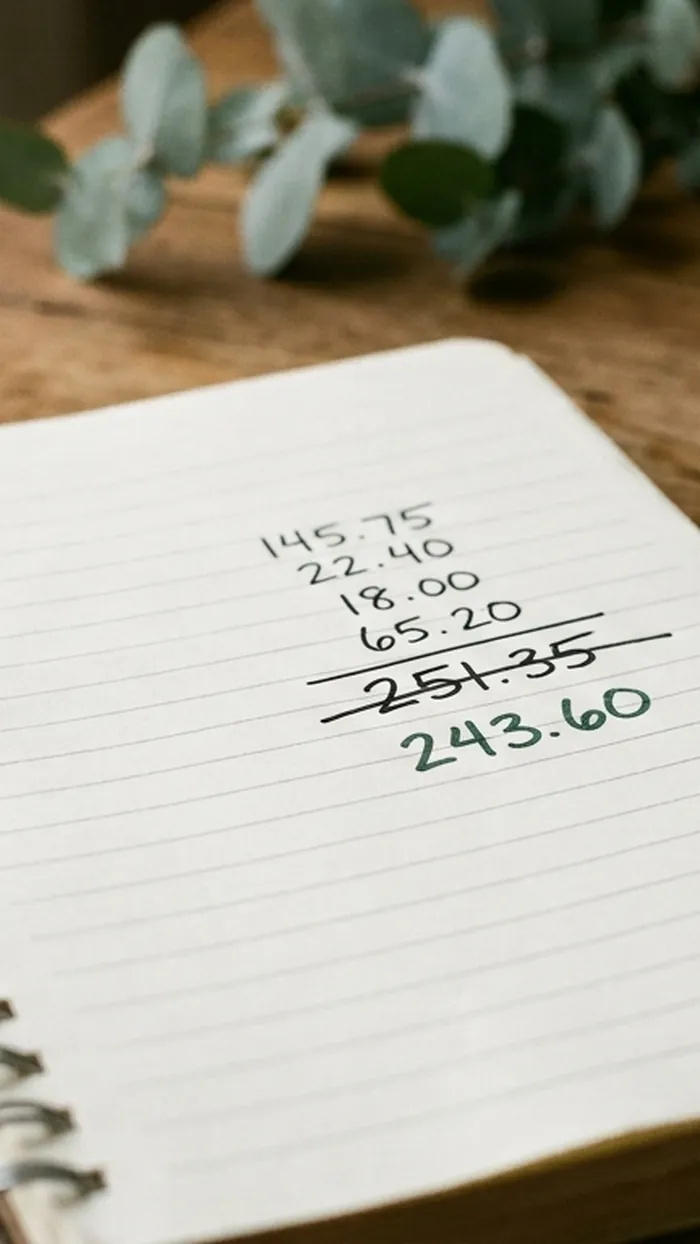
A complete first budget, filled in
Steps are easier to follow when you can see the finished thing. This is what a first budget looks like for someone taking home $3,200 a month.
| Line | Monthly | Notes |
|---|---|---|
| Rent | $1,150 | Fixed |
| Utilities and phone | $180 | Varies a little, budget the high month |
| Groceries | $400 | The number most people underestimate |
| Transport | $160 | Fuel or transit pass |
| Insurance | $120 | Fixed |
| Debt minimums | $190 | Card and loan minimums |
| Fixed and essential | $2,200 | 69% of take-home |
| Spending money | $600 | Eating out, subscriptions, everything fun |
| Savings | $400 | Moved on payday, before anything else |
Essentials come to $2,200, which leaves $1,000. Splitting it $600 spending and $400 savings is a choice, not a rule. The point of writing it down is that the $1,000 now has a job, instead of quietly disappearing by the 20th.
If your essentials come to more than your take-home, the budget is not the problem and no amount of tracking will fix it. That is an income or a fixed-cost problem, and it is worth naming rather than budgeting around.
The month you overspend (and you will)
Let us be honest now so it does not derail you later: you will blow your budget some month. Not might. Will.
This is the exact moment most people quit. One bad month feels like proof the whole thing was pointless. It is not. A budget is not a contract you breached. It is a measurement that came back high. The boring, effective response: look at why, adjust one number, carry on. No guilt spiral, no starting over.
The people who succeed at budgeting are not the ones who never overspend. They are the ones who do not let one overspend end the habit. That single idea is why most budgets fail, and why this one will not.
Where the savings should go
Your savings category needs a destination, or it leaks back into spending. Send it first to a small emergency fund, then to sinking funds for the bills you know are coming, then to any goal you are working toward. Money with a job assigned is money that actually stays saved.
How to make it stick
Three things separate a budget that lasts from one that does not. Anchor your monthly review to payday, so a fixed trigger replaces memory. Keep it small, because the more elaborate it is, the more likely you skip it. And forgive the misses, because a habit survives imperfect repetition and dies from all-or-nothing thinking.

If you want the first month already laid out for you, the free One-Month Money Reset Kit walks through take-home pay, bills and spending in one pass, then closes the month with a review.
Frequently asked questions
How do I start a budget for the first time?
Find your take-home pay, list the bills you cannot skip, then track your spending for two to four weeks before setting any limits. Once you can see where the money goes, give it five simple jobs: bills, food, transport, fun, and savings.
What is the easiest budget for beginners?
A five-category split or the 50/30/20 rule. Both avoid the trap of thirty fiddly categories that take too much upkeep. The easiest budget is whichever one you will still be using in three months, which usually means the simplest.
How much of my income should go to savings?
A common target is 20% of take-home pay, but start with whatever you can repeat without fail, even 5%. Move it on payday before you spend, and increase it slowly as your income grows or your costs drop.
Why do I keep failing at budgeting?
Usually because the budget had no room for normal life and no plan for the month you overspend. One slip feels like failure, so you quit. A budget that expects bad weeks and lets you adjust one number survives them.
How often should I update my budget?
A quick weekly glance plus one slightly longer review each month is plenty. Daily tracking is the friction that kills the habit for most people. Anchor the monthly review to payday so you never forget it.
How do I start budgeting if I have no money left at the end of the month?
Start by tracking, not cutting. For one month, write down every expense without changing anything. The first budget is a map of where money already goes. Then pick one small, visible win — one subscription, one category, one sinking fund — and redirect that amount to savings on payday. The guide on saving when you live paycheck to paycheck walks through the tight-income version step by step.
What is the best budgeting method for beginners?
The one you will check weekly. For most beginners that is either 50/30/20, because it is three buckets, or pay-yourself-first, because savings moves before spending starts. We compared five options side by side in best budgeting methods for beginners, including who each method suits and who should skip it.
Start this week
Do not aim for the perfect budget today. Aim for the simplest one you will still be using at the end of the year. Find your take-home pay, list your bills, and start watching where the rest goes. You can revise next month, which is the entire point.
Free kit
If you'd rather not build your first budget from scratch, the free One-Month Money Reset Kit gives you a done-for-you month to start with.
Found this useful?
Pin it to come back to laterKeep reading
A few useful next steps
The 50/30/20 Budget Rule, Explained Simply
The 50/30/20 budget rule explained with examples at three incomes: 50% needs, 30% wants, 20% savings. Calculate yours and adjust it when rent is high.
Best Budgeting Methods for Beginners: 5 Systems Compared
The best budgeting methods for beginners compared: 50/30/20, zero-based, pay yourself first, envelopes and the 80/20 rule. Who each suits, and what to skip.

How to Budget When Your Income Is Different Every Month
A calm budgeting method for freelance, commission, shift, or variable pay. Budget on last month's income, build a buffer month, and stop dreading slow ones.