

Debt Consolidation vs a Debt Payoff Plan: Which One Actually Saves You More?
Debt consolidation rolls your balances into one loan. A payoff plan just tells you what order to attack them in. Here is the real math on when each one wins.
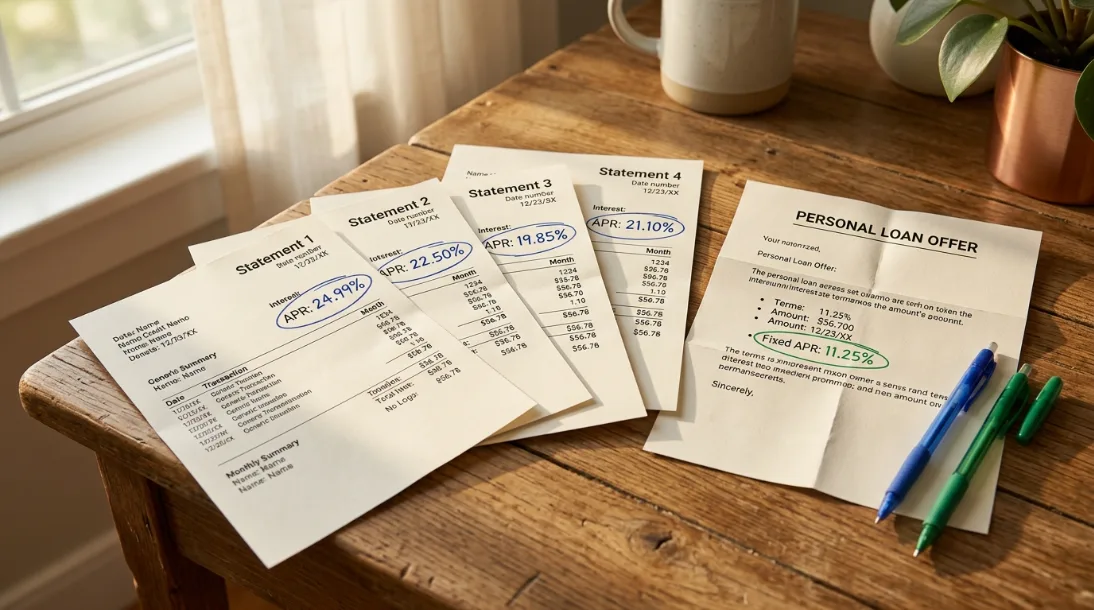
US credit card balances are now well over a trillion dollars, tracked quarterly in the New York Fed’s Household Debt and Credit Report, and ads for “debt consolidation” are everywhere the moment your balance starts climbing. The pitch sounds simple: roll everything into one loan, one payment, done. But consolidation is not a payoff plan. It is a tool, and like any tool, it helps in some situations and quietly makes things worse in others.
Here is how to tell which one you actually need.
What each one actually does
A debt payoff plan, like the snowball or avalanche, does not change your debt at all. It just tells you the order to attack it in, using money you already have spare each month. Debt consolidation is different. It replaces several debts with one new loan, usually at a lower interest rate than your credit cards, which can genuinely cut what you pay in interest.
| Debt payoff plan | Debt consolidation | |
|---|---|---|
| What changes | The order you pay debts in | The debt itself, into one new loan |
| Needs approval | No | Yes, a new loan or balance transfer |
| Interest rate | Stays the same | Often lower, if you qualify |
| Risk | Slower if you lose motivation | Old cards stay open and can refill |
| Best for | Debt you can clear in 1 to 3 years | High-rate debt you cannot outpace alone |
Consolidating or refinancing existing debt is consistently one of the most common reasons people take out a personal loan at all. That is not a fringe move, it is one of the standard ways people deal with expensive balances.
When consolidation actually helps
Consolidation earns its keep in one specific situation: your current interest rate is so high that minimum payments barely touch the balance. If you are carrying $8,000 across three cards at 22 to 27 percent, a consolidation loan at 11 or 12 percent is not a gimmick. It is real money staying in your pocket instead of going to interest, and it can shave years off how long the debt follows you around. Exactly how much a rate gap changes the outcome is worth seeing worked through with real numbers before you commit to a loan.
It also helps your sanity. One payment, one due date, one number to watch, instead of juggling four minimums and hoping none of them get missed.

When it makes things worse
Consolidation does not close your old credit cards, it just empties them. And an empty card with a $0 balance is, for a lot of people, an open invitation. This is the single most common way consolidation backfires: you pay off the cards with the new loan, feel the relief, and six months later the cards are full again, except now you also owe the loan. You have not gotten out of debt, you have added a new debt on top of the old habit.
It is also worth the math check. If your rates are not dramatically different, or the loan comes with an origination fee that eats the savings, a plain payoff plan on your existing debts can beat consolidation with zero paperwork and zero new risk.
Consolidation only works if the empty cards stay empty. If you cannot promise yourself that honestly, a payoff plan is the safer tool, not the slower one.
A quick way to decide
Ask yourself three questions:
- Is my current rate actually high? If your average rate is under 15 percent, consolidation probably will not move the needle much. Above 20 percent, it likely will.
- Can I get approved for something meaningfully lower? Check the real rate you would qualify for before assuming it beats your cards. Your credit score decides this, not the ad.
- Will I close or freeze the old cards once they are paid off? If the honest answer is no, skip consolidation and go straight to a payoff order instead.

Consolidation works when
- The new rate is genuinely lower than your weighted average, after fees
- You qualify for the advertised rate, not the "from" rate
- The cards get closed or frozen once cleared
- One payment date genuinely helps you not miss one
It backfires when
- The term stretches so far that a lower rate still costs more overall
- An origination fee eats the saving
- The cleared cards get used again, so now you have both
- The promotional rate expires before the balance does
The honest part
Consolidation feels like progress because the number of things you owe drops to one. But the debt has not shrunk, it has just moved. The only version of this that actually works long term pairs the lower rate with the same discipline a payoff plan requires anyway: know where every dollar goes, so the old cards do not quietly refill. If you have not sorted that yet, start with the 50/30/20 rule so you know what is actually spare each month.
And if the real problem is that your income does not stretch far enough no matter which method you pick, no loan restructuring fixes that. That is an income problem, and a small side hustle will do more for it than any interest rate will. If that is the honest answer, start from the ways to earn more rather than another payoff calculator.
And if you are still not certain what is genuinely spare each month, the free One-Month Money Reset Kit has a savings and debt priorities page for working that out on paper.
Frequently asked questions
Is debt consolidation a good idea?
It can be, if your current interest rate is high and you can qualify for a meaningfully lower one. It works best for people who will not run their old cards back up once they are empty. If that is not a safe bet for you, a payoff plan on your existing debts is usually the better move.
Does debt consolidation hurt your credit score?
There is often a small, short-term dip from the new credit check and the new account, but paying down one consolidated balance on time tends to help your score within a few months, mainly by lowering your credit utilization. The same dip-then-climb pattern shows up with a plain payoff plan too; what actually moves the number covers the mechanism either way.
What is the difference between debt consolidation and a debt payoff plan?
Consolidation replaces multiple debts with one new loan, usually at a lower rate. A payoff plan does not create new debt, it just orders your existing balances so you pay the smallest, or the highest interest, first. Consolidation changes the debt. A payoff plan changes the order.
Should I close my credit cards after consolidating?
Closing them removes the temptation to refill them, which is the main risk of consolidation. It can very slightly affect your credit history length, but for most people that is a smaller concern than a card sitting open at a zero balance.
Can I consolidate debt without a loan?
Yes, a balance transfer card with a 0 percent introductory rate does the same job for smaller balances, as long as you can clear it before the promotional period ends and the rate jumps back up.
One calm next step
List every balance with its real interest rate next to it. If your average is comfortably under 15 percent, skip the loan paperwork and pick a payoff order instead. If it is well above that, spend twenty minutes checking what rate you would actually qualify for before deciding.
Free kit
Whether you consolidate or not, the free One-Month Money Reset Kit has a debt-priorities page built in, so you can see exactly what is spare each month before you sign anything.
Found this useful?
Pin it to come back to laterKeep reading
A few useful next steps
Debt Snowball vs Avalanche: Which Payoff Method Actually Works?
The debt snowball saves your motivation. The avalanche saves your money. A side by side comparison with a worked example, and how to pick the one you'll finish.

Does Paying Off Debt Raise Your Credit Score? What Actually Moves It
Paying off debt does not move your score the way most people expect. What actually changes it while you pay, and why the number sometimes dips first.

How Interest Rates Change Your Debt Payoff Plan (and What to Do About It)
Rate checks have become a habit for a reason. What actually changes for your debt when rates move, and how to adjust your plan, not just watch headlines.