
High-Yield Savings Accounts, Explained: Is Switching Banks Worth It?
The average savings account pays a fraction of a percent. High-yield accounts pay ten times that, what the difference looks like, and how to switch.
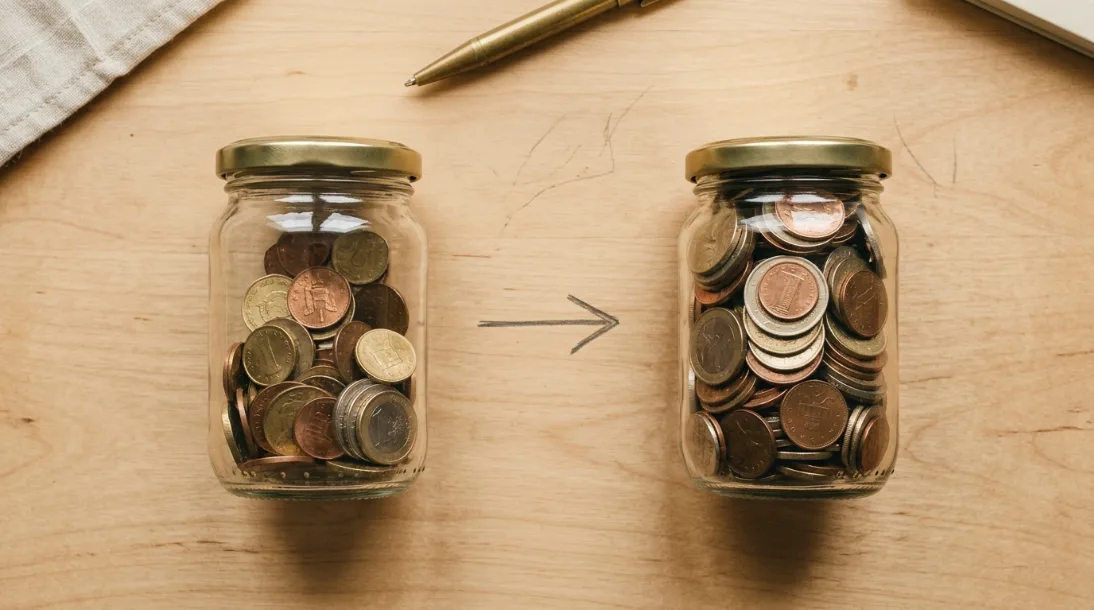
Here is a number worth sitting with: the national average savings rate is a fraction of a percent, published and updated by the FDIC. Meanwhile a long list of online banks pay several percent on the exact same kind of account. Same safety, same FDIC insurance, same “put money in, take money out” simplicity. The only difference is which bank you picked.
Rates move, so check both numbers on the day you decide rather than trusting any figure in an article, including this one.
If your savings has been sitting in whatever account your checking is attached to, this is probably the single easiest money move available to you right now.
What “high-yield” actually means
A high-yield savings account is just a regular savings account that pays a meaningfully higher interest rate, usually offered by an online-only bank instead of a traditional branch bank. Online banks skip the cost of physical branches and pass some of that savings back to you as interest. Your money is not riskier for it. As long as the bank is FDIC-insured, which the legitimate ones are, you are covered to the standard FDIC limit of $250,000 per depositor, per insured bank, per ownership category, exactly like a big-name branch bank.
What the gap actually costs you
Say you are holding $5,000 in savings. The rates below are illustrative, not today’s numbers, so you can see the shape of the gap rather than a figure that goes stale.
| Average savings account (~0.4%) | High-yield account (~4%) | |
|---|---|---|
| Interest in one year | About $20 | About $200 |
| Interest in three years | About $60 | About $612 |
That is not a rounding error, it is roughly ten times more, for doing nothing except moving the money. On a larger emergency fund, the gap gets proportionally bigger. This is free money that a lot of people are simply leaving on the table because switching banks feels like a hassle it usually is not.

The interest rate on your savings account is one of the only financial numbers you can improve in twenty minutes, with no risk and no ongoing effort.
Is it actually worth switching?
For most people, yes, with one real caveat: only move money you will not need to touch through a physical branch or ATM regularly. Online high-yield accounts are built for emergency funds, sinking funds, and general savings you are not dipping into weekly. If you need frequent cash withdrawals or in-person banking, keep a smaller working balance at your regular bank and move the rest.
How to actually switch, without the hassle
- Open the new account first, keep the old one open. You do not need to close anything until the transfer is confirmed and cleared.
- Transfer a small test amount first. Confirm it lands before you move your full balance.
- Move your full savings balance once confirmed. Most transfers between linked bank accounts take one to three business days.
- Leave your checking account exactly where it is. This is about where your savings sits, not your day-to-day spending account.
- Set up automatic transfers into the new account. This is also the easiest moment to build an automatic saving habit, since the account is already new.

The honest part
A high-yield account will not fix a budget that has no spare money in it. The interest only works on money that is actually sitting there. If saving anything at all still feels impossible right now, that is a budgeting problem to solve first, and why saving money feels impossible is the honest starting point. Once there is money to save, moving it somewhere that actually pays you for holding it is close to a free decision.
Rates do shift over time, so it is worth checking your account’s current rate against what is available elsewhere once or twice a year, the same way you would check any other bill.
And if the harder question is whether there is anything spare to move at all, the free One- Month Money Reset Kit is built to answer exactly that in one month.
Is a high-yield savings account worth it for an emergency fund?
Yes, for most people. It is the best balance of safety, interest and access for money you might need on short notice — which is why it is our top pick for where to keep your emergency fund. The only people who should skip it are those who would not open one today out of friction: a separate regular savings account opened now beats a perfect account opened never.
Frequently asked questions
Is a high-yield savings account worth it?
For most people, yes. It pays meaningfully more interest than a typical savings account, with the same safety and FDIC insurance, and takes about twenty minutes to set up. The only real downside is limited or no physical branch access.
Is my money safe in an online high-yield savings account?
As long as the bank is FDIC-insured, your money is protected up to $250,000 per account holder per bank, identical to protection at a traditional branch bank. Confirm FDIC insurance before opening any account.
How much interest does a high-yield savings account actually earn?
It depends on the rate on the day, so check the FDIC national average against what the account you are considering pays. As an illustration: at 4 percent, $5,000 earns roughly $200 in a year, against roughly $20 in an account paying under half a percent. The gap grows with a larger balance.
What is the difference between a high-yield savings account and a regular one?
They function identically for deposits, withdrawals, and safety. The difference is purely the interest rate, which is usually far higher at online-only banks because they do not carry the cost of physical branches.
How long does it take to switch to a high-yield savings account?
Opening the account itself usually takes minutes online. Transferring money between linked bank accounts typically takes one to three business days, so plan for a short gap rather than an instant move.
One calm next step
Check the interest rate on your current savings account, then compare it against a couple of FDIC-insured online banks. If the gap is anywhere close to what is typical right now, open the new account and move a small test transfer over this week.
Free kit
The free One-Month Money Reset Kit helps you find what is actually spare to save each month, so a better interest rate has something real to work on.
Found this useful?
Pin it to come back to laterKeep reading
A few useful next steps
The 100 Envelope Challenge: How to Actually Save $5,050
The 100 envelope challenge saves $5,050 in 100 days. How it works, how much you save weekly, a lower-income version, and how to actually finish it.
The 52 Week Savings Challenge, Reworked for Real Pay
Save about $1,378 in a year, one deposit a week. How the 52 week challenge works, a friendlier version for real budgets, and how to finish it.
Cash Stuffing Without the Cash: Digital Envelopes That Actually Work
Cash stuffing for beginners without carrying cash: how digital envelopes work, the best categories to stuff, and when physical cash still helps.