

Where Should You Actually Keep Your Emergency Fund?
Where to keep your emergency fund: a high-yield savings account wins for most people. Compare HYSA vs regular savings vs cash and access speed.
So you have started saving an emergency fund. Good. Now comes the small question that quietly trips people up: where do you actually keep it?
It matters more than it sounds. The right home keeps the money safe, available when you need it, and far enough from your everyday spending that you do not nibble at it on a normal Tuesday. The wrong home either tempts you to spend it or locks it up when you need it most.
Here are the real options, in plain terms, with the honest trade off of each.
The short answer
For most people, the best place to keep your emergency fund is a separate high-yield savings account (HYSA) at a different bank from your everyday checking. It stays FDIC-insured, earns real interest, and takes 1-3 days to reach you — close enough for a real emergency, far enough to stop impulse spending. Keep $500-$1,000 instantly available in regular savings if your income is unsteady.
Where should I keep my emergency fund?
If you searched “where to keep your emergency fund”, “where to keep emergency fund” or “best place to keep emergency fund”, the ranking is the same in almost every situation:
- High-yield savings account — best balance of safety, interest and access for most people. See how much the rate difference is actually worth in high-yield savings accounts, explained.
- Separate regular savings account — fine if opening a new bank feels like too much friction today. Separation matters more than the rate for your first $1,000 emergency fund.
- A small amount of cash at home — useful for a power cut or a card freeze, not as the main home for the fund.
What changes the answer is not the account name. It is how fast you need the money, and how likely you are to spend it if it sits next to your bills. The comparison below makes that trade-off concrete.
Once the fund has a home, give it a target and a refill rhythm. A visible goal helps — many people build the first layer with a savings challenge and then move the money into the HYSA each week so the challenge cash does not sit in a drawer.
Option 1: A separate savings account
The simplest choice, and a perfectly good one. A second savings account at your existing bank, kept apart from your checking.
The strength is separation. The money is out of sight, so it is out of mind, and you are far less likely to spend it by accident. As long as the bank is FDIC-insured you are covered to the standard deposit insurance limit of $250,000 per depositor, per insured bank, per ownership category. It is instant to access when a real emergency hits. The trade off is that a standard savings account at a big bank earns almost no interest, so your money sits safe but flat.
Option 2: A high yield savings account
For most people, this is the best home for an emergency fund, and it is what we would point you to first.
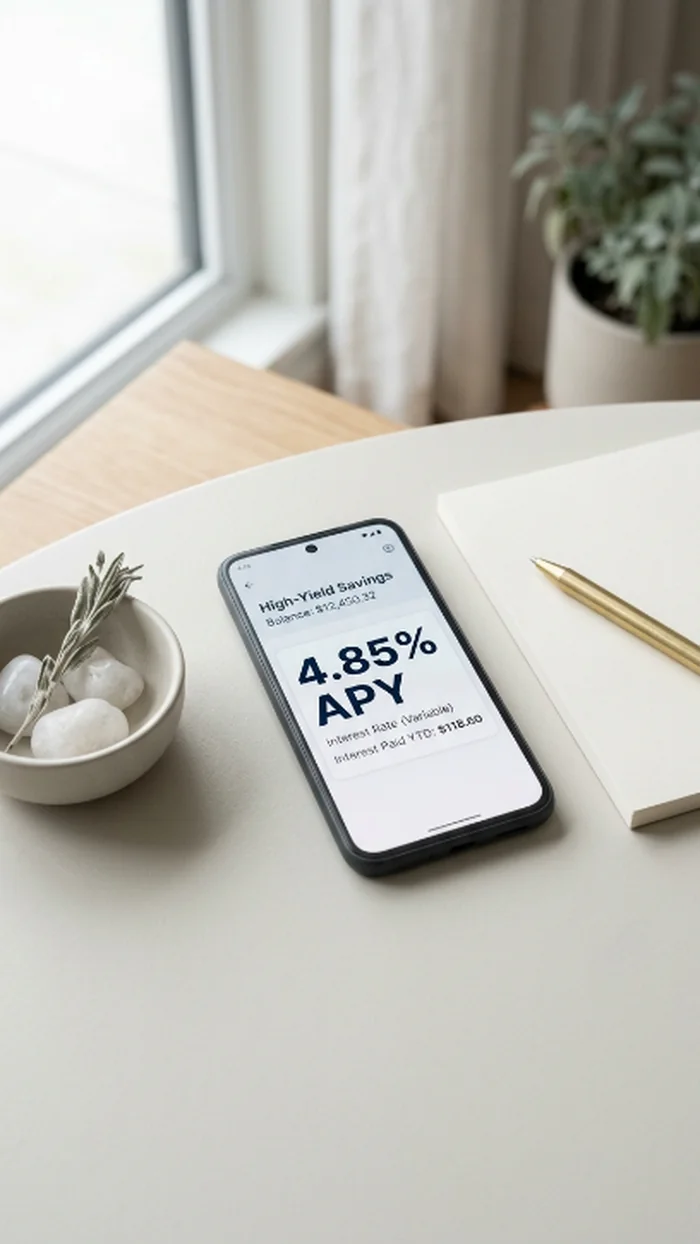
It works exactly like a normal savings account. The money is safe and you can usually move it to your checking within a day. The difference is that it earns meaningfully more interest, often several times what a big bank pays. So your fund stays just as safe and available, and quietly earns a little while it waits for an emergency that may never come.
The trade off is minor. These accounts are usually online only, so there is no branch to walk into, and a transfer can take a day rather than being instant. For money you hope to never touch, that is a fair deal. If you already have savings sitting in a standard account, the math on switching is worth seeing in actual dollars before you decide it is not worth the hassle.
Option 3: Cash in an envelope
The most visible option, and the right one for some people. Physical cash, kept in a labeled envelope or a safe at home.
The strength is pure tangibility. There is no app, no transfer, and no temptation to invest it. If cards are your weak spot, seeing real cash can keep you honest. But the trade offs are real: cash earns nothing and slowly loses value to inflation, it can be lost or stolen, and it is not covered the way bank deposits are. Cash suits a short, motivating push more than a fund you hold for years.
What to avoid
Two homes feel clever but cause problems. Do not keep your emergency fund in your everyday checking account, because it always gets spent. And do not invest it in stocks or anything that can drop in value, because the market can be down at exactly the moment your car breaks down. An emergency fund’s whole job is to be boring, safe, and there.
Wherever it lives, the one rule that matters: keep it separate from the money you spend, so an emergency is the only thing that ever touches it.
The three options, side by side
| Separate savings account | High-yield savings | Cash at home | |
|---|---|---|---|
| Access speed | Same day | One to three days | Instant |
| Interest earned | Very little | Meaningfully more | None |
| Protected if the bank fails | Yes, if FDIC-insured | Yes, if FDIC-insured | No |
| Protected if lost, stolen or burnt | Yes | Yes | No |
| Temptation to spend it | Moderate | Low | High |
| Best for | Most people | Anyone not dipping in weekly | A small buffer only |
The two rows people weigh are speed and interest. The two rows that actually decide it are the protection ones, which is why cash beyond a small buffer is a worse idea than it feels.
A quick way to choose
- Want simple and you bank in person? A separate savings account.
- Want your money to earn while it waits? A high yield savings account. Best for most.
- Struggle with cards and want it visible? Start with cash, then move it to a high yield account as it grows.
This is also exactly how to store sinking funds and the money from any savings challenge. Separate, safe, and easy to track.
And if the amount going in is the part you are unsure about, the free One-Month Money Reset Kit works out what one real month leaves spare.
Frequently asked questions
Where is the best place to keep an emergency fund?
A high yield savings account is the best home for most people. It keeps the money safe and accessible within a day while earning meaningfully more interest than a standard account. Keep it separate from your everyday checking so you do not spend it by accident.
Should I keep my emergency fund in a high yield savings account?
Yes, for most people. It earns several times what a big bank pays, the money stays safe, and you can usually move it to checking within a day. The only minor downsides are that these accounts are often online only and transfers are not instant.
Should I invest my emergency fund?
No. An emergency fund needs to be safe and available the moment you need it, and investments can fall in value at exactly the wrong time. Keep it in cash savings and invest separately, only after the fund is built.
How much of my emergency fund should be in cash?
Most people do not need any physical cash, but keeping a small amount at home can help in a power or banking outage. The bulk should sit in a high yield savings account where it is safer, insured, and earning interest.
Can I keep my emergency fund in my checking account?
It is not recommended. Money in your checking account is too easy to spend without noticing. Keep the fund in a separate account so it stays untouched until a genuine emergency.
Where should you keep your emergency fund if you live paycheck to paycheck?
Keep it in a separate savings account, even if it starts with $25. If you live paycheck to paycheck, instant access and separation beat chasing the highest rate. Move it to a high-yield savings account once you have your first $500-$1,000 — the steps in how to save money when you live paycheck to paycheck show how to find that first amount.
Is a money market account a good place to keep an emergency fund?
It can be. A money market account often works like a high-yield savings account with similar insurance through its bank, and sometimes a debit card or cheques. Compare the rate, any minimum balance, and how many days a transfer to your main bank takes. If a plain HYSA is simpler and pays the same, choose the simpler one.
Start this week
Pick the home that fits you, open it if you need to, and move your emergency savings there today, out of reach of everyday spending.
Free kit
Once you know where the money lives, the free One-Month Money Reset Kit helps you track it moving there, one month at a time.
Found this useful?
Pin it to come back to laterKeep reading
A few useful next steps
The 100 Envelope Challenge: How to Actually Save $5,050
The 100 envelope challenge saves $5,050 in 100 days. How it works, how much you save weekly, a lower-income version, and how to actually finish it.
The 52 Week Savings Challenge, Reworked for Real Pay
Save about $1,378 in a year, one deposit a week. How the 52 week challenge works, a friendlier version for real budgets, and how to finish it.
Cash Stuffing Without the Cash: Digital Envelopes That Actually Work
Cash stuffing for beginners without carrying cash: how digital envelopes work, the best categories to stuff, and when physical cash still helps.