

The 2026 Money Saving Challenges Worth Trying (and the Ones to Skip)
Every January the same savings challenges start circulating. Which ones actually build a habit, which fizzle by week three, and how to pick one.
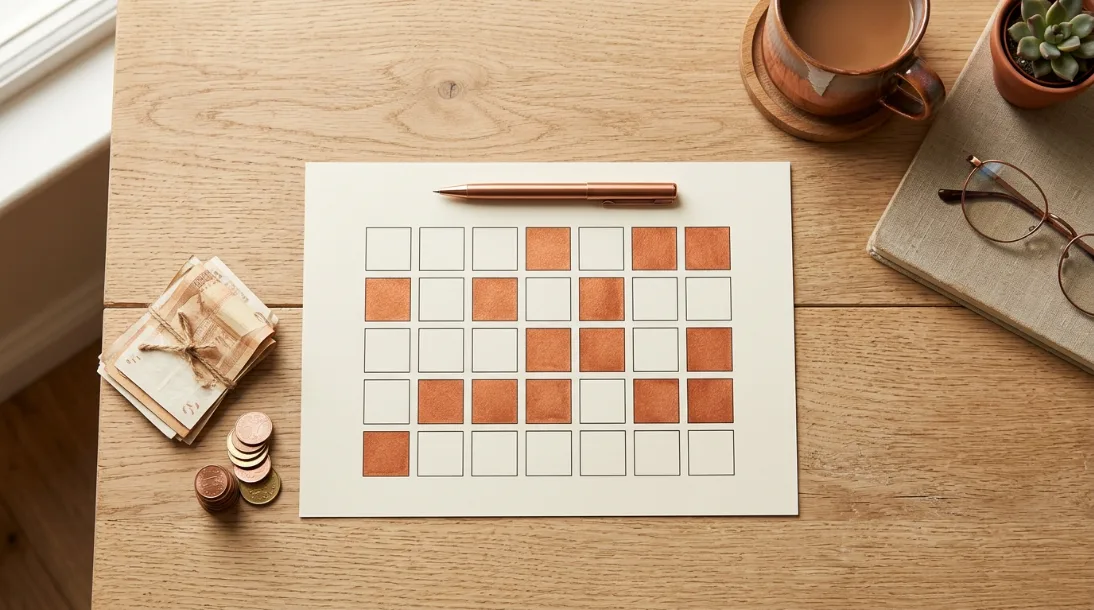
A new savings challenge shows up every year with a new number attached to it, and honestly, most of them are the same idea wearing a different outfit. That is not a criticism. The repetition is the point. A challenge works by giving you a simple rule and a finish line, and the specific number matters far less than whether you actually stick with it.
Here is a straight look at the ones actually worth your time this year.
Trending savings challenges, and what they actually save
Searches for “trending savings challenges” keep resurfacing the same handful of ideas. Here is what each one really delivers, minus the hype:
- 100 envelope challenge — $5,050 in about 100 days. The most viral, and the one most people quietly quit. Our 100 envelope guide covers the slower pace that survives.
- 52 week challenge — about $1,378 in a year, with the painful weeks landing at Christmas. The friendlier version fixes that.
- No-spend month — the amount varies, but most households find $200-$400 they did not know they were spending.
- $1-a-day / round-up challenges — a few hundred a year, but with the highest finish rate of anything here.
If you want the full menu to browse, we listed twelve options matched to income and pace in savings challenge ideas.
The challenges, compared
| Challenge | How it works | Best for |
|---|---|---|
| 52-week challenge | Save a rising amount each week, from $1 up to $52 | Steady, predictable savers |
| 100-envelope challenge | Fill 100 numbered envelopes with matching cash amounts | Visual, hands-on savers |
| Biweekly challenge | Save a fixed or rising amount every payday instead of every week | Anyone paid biweekly |
| 800 savings plan | Save toward a fixed $800 goal using small varied deposits | People who want a short, defined finish line |
| No-spend month | Cut all non-essential spending for a set stretch | A reset after overspending |
None of these are “the best” one objectively. The best one is the one shaped like your actual pay schedule and personality, which is the part most roundups skip.

Why the 52-week challenge works for some people and not others
The classic version has you save $1 the first week, $2 the second, climbing to $52 by the end of the year, totaling around $1,378. It is satisfying on a spreadsheet, but the back half gets expensive fast, often $40 to $52 a week right when holiday spending is climbing too. A flipped version, starting high and decreasing, front-loads the hard weeks while your motivation is freshest, so the amount is falling exactly when the routine starts to feel old.
Why the biweekly challenge is underrated
If you are paid every two weeks rather than weekly, a challenge built around a Monday-to-Sunday week creates constant friction, wrong math on payday, deposits that fall on the wrong day. A biweekly version, saving a set or rising amount each payday instead, matches how your money actually moves. It sounds like a small adjustment, but it is often the difference between a challenge that survives March and one that quietly dies in February.
The challenge that finishes is the one that matches your actual pay schedule, not the one with the most satisfying spreadsheet.

Why the no-spend month is the one people underestimate
A no-spend month is not really about the money saved during those thirty days, though that adds up too. It is a reset. It shows you exactly how much of your normal spending is genuinely automatic, ordering food, subscriptions you forgot about, small daily purchases, and that awareness tends to outlast the month itself. Pair it with canceling the subscriptions you find along the way for a savings boost that sticks around after the challenge ends.
How to actually pick one
- Match it to your pay schedule. Weekly challenges for weekly pay, biweekly for biweekly pay. Fighting your own calendar is the fastest way to quit.
- Pick a number you can survive in the hardest week, not the easiest. A challenge that breaks you in week nine is worse than a smaller one you actually finish.
- Make it visible. A sinking fund tracker, a printed chart, an app, anything that shows progress. Momentum needs to be seen to keep working.
- Give it a real finish line and a real reason. “Save money” is vague. “$800 for December gifts” finishes.
The honest part
A savings challenge is scaffolding, not a strategy. It works because it makes saving feel like a game with a finish line, which is genuinely useful for building the habit. But once the challenge ends, the habit needs to become part of your regular budget, or the savings rate quietly falls back to zero. The 50/30/20 rule is a good place to land once the challenge is over, so the saving keeps happening without a countdown attached to it.
And if you would rather start by seeing what a normal month leaves spare, the free One-Month Money Reset Kit does that in a single pass.
What are the best savings challenges for 2026?
For most people: the slower-paced 100 envelope challenge, the flat-rate 52 week challenge, or the $1-a-day challenge if money is tight. The “best” one is always the one you will finish, so pick from the gentle tier first and level up after a completed round.
Are savings challenges worth doing, or just a gimmick?
They work when the weekly amount is honest. A challenge removes daily decisions and makes progress visible, which is exactly what most budgets lack. They fail when the total exceeds your real spare money — a sizing problem, not a discipline problem.
Frequently asked questions
What is the best money saving challenge for 2026?
There is no single best one. A biweekly challenge fits anyone paid every two weeks, the 100-envelope challenge suits visual, cash-based savers, and a no-spend month is best for resetting after a period of overspending. Match the format to your pay schedule and personality, not the trend.
How much can you save with the 52-week savings challenge?
The classic version, saving $1 more each week up to $52, totals around $1,378 over the year. A flipped version starting high and decreasing reaches the same total, but puts the hardest weeks first, while your motivation is highest, rather than last.
What is the 800 savings challenge?
It is a shorter, defined-goal challenge where you save toward a fixed $800 target using a series of smaller, varied deposits rather than one steady weekly amount. It works well as a short-term goal, like holiday spending or a specific purchase.
Do savings challenges actually work?
They work well for building momentum and making saving feel achievable, especially for people who have struggled to save consistently. The habit only sticks long-term if it gets folded into a regular budget once the challenge ends.
What should I do after I finish a savings challenge?
Keep the habit going by building your new savings amount into your regular budget instead of letting it drop back to zero. A percentage-based system like the 50/30/20 rule keeps the momentum without needing a new challenge every time.
Start this week
Pick one challenge from the table that actually matches your pay schedule, not the one with the biggest number attached. Write down your real finish line and the reason behind it, then set up the first deposit today, while the motivation is highest.
Free kit
The free One-Month Money Reset Kit has a simple savings tracker built in, so whichever challenge you pick has somewhere to actually live after week one.
Found this useful?
Pin it to come back to laterKeep reading
A few useful next steps
The 100 Envelope Challenge: How to Actually Save $5,050
The 100 envelope challenge saves $5,050 in 100 days. How it works, how much you save weekly, a lower-income version, and how to actually finish it.
The 52 Week Savings Challenge, Reworked for Real Pay
Save about $1,378 in a year, one deposit a week. How the 52 week challenge works, a friendlier version for real budgets, and how to finish it.
Cash Stuffing Without the Cash: Digital Envelopes That Actually Work
Cash stuffing for beginners without carrying cash: how digital envelopes work, the best categories to stuff, and when physical cash still helps.